Full-stack data engineering, on-site at ExxonMobil
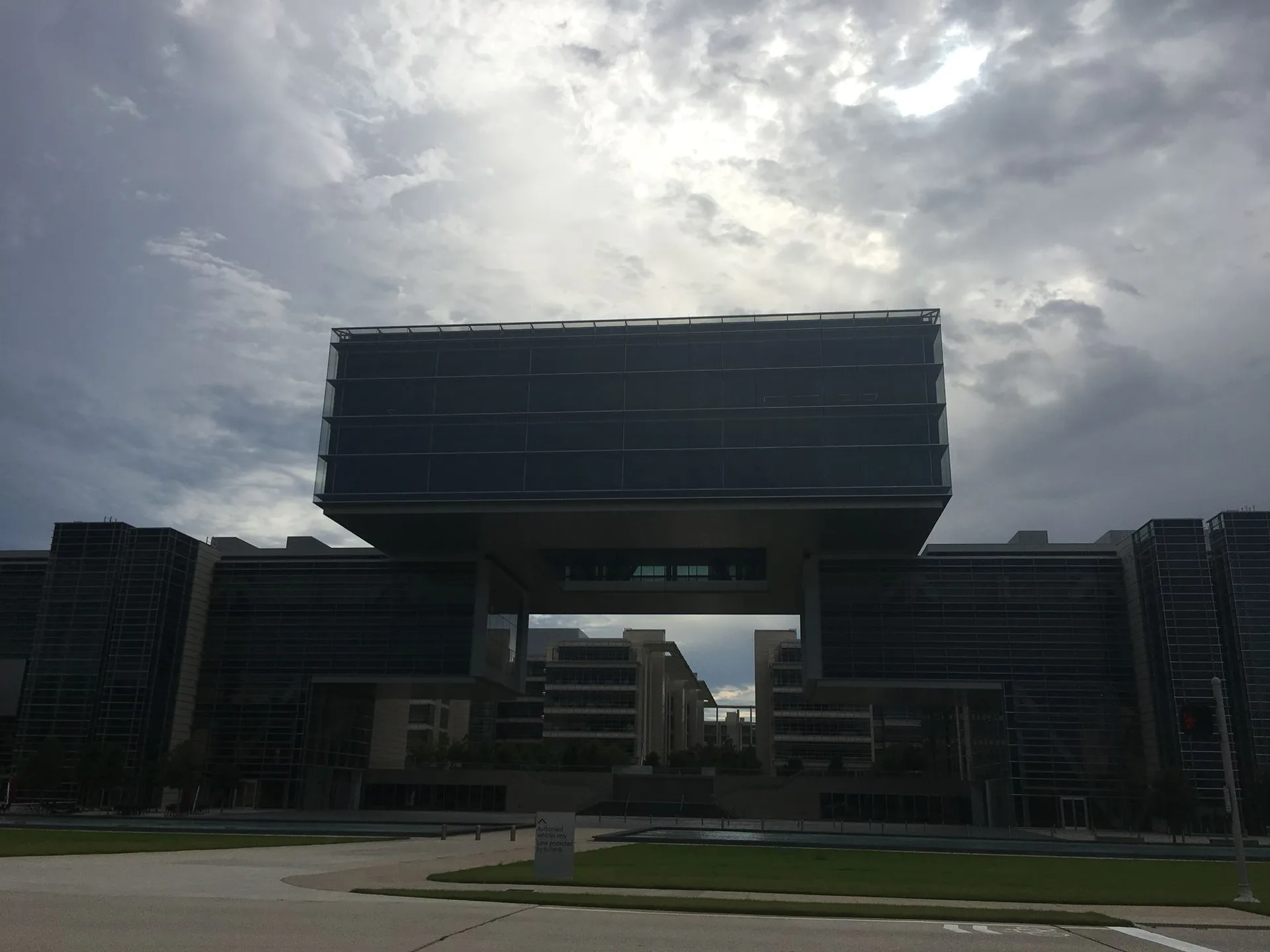
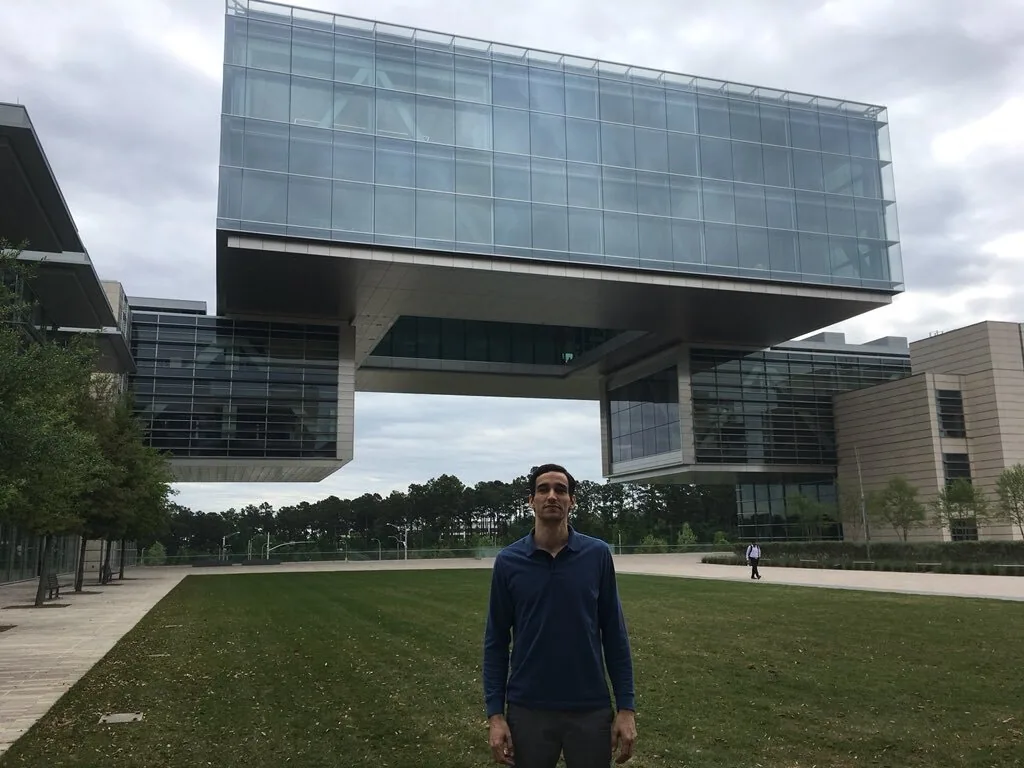
On-site at ExxonMobil in Houston, our founder Tyler Garrett built the data layer end to end: ingestion from raw source systems, ETL pipelines in Alteryx, data warehouse design, and streaming occupancy dashboards covering more than 80 campuses — badge and sensor data turned into a live view facilities teams could act on. This is the whole point of data engineering done right: the model underneath is designed, not accumulated, so everything on top of it stays fast and trustworthy.
Platform automation & infrastructure
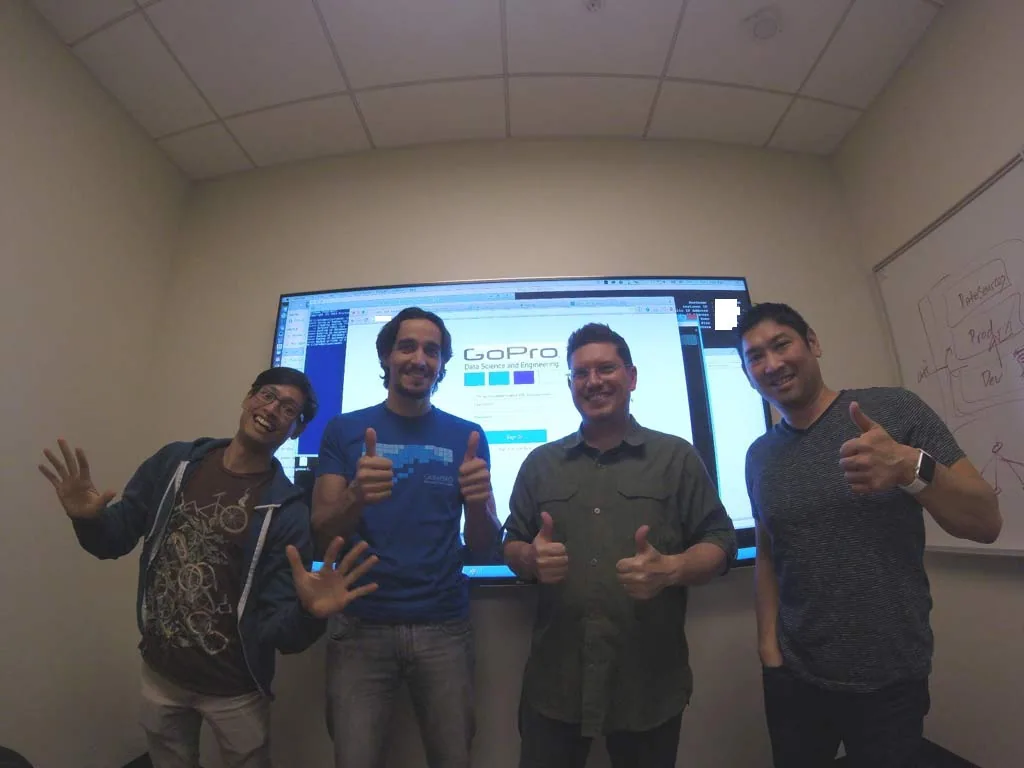
Data engineering is not just pipelines — it is the automation and infrastructure that keep them running. On-site at GoPro, Tyler Garrett wrote custom PowerShell automation and migrated a single-node deployment to a high-availability cluster, completed and optimized in a single day. GoPro's team: "We finished with our requirements three times faster than our team expected."
Read the GoPro case study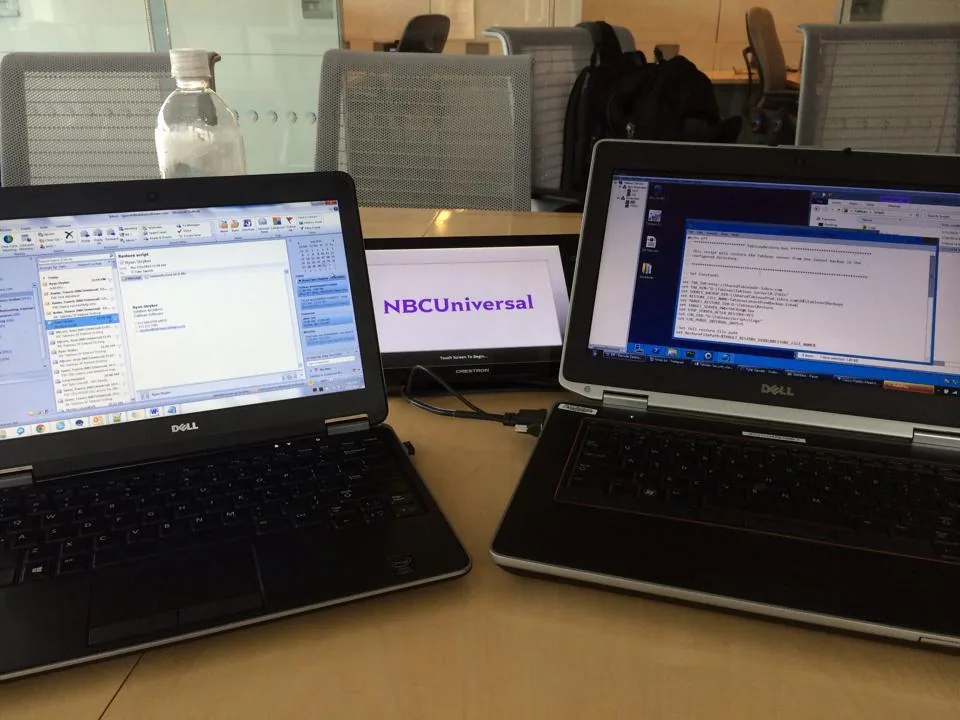
Enterprise data at media scale
On-site at NBC, we saw how a major media enterprise runs its data operation at scale — the ingestion cadence, the governance, and the reporting reliability that keep analytics trustworthy for thousands of users. That perspective shapes how we design pipelines and warehouse models that hold up under real enterprise load.
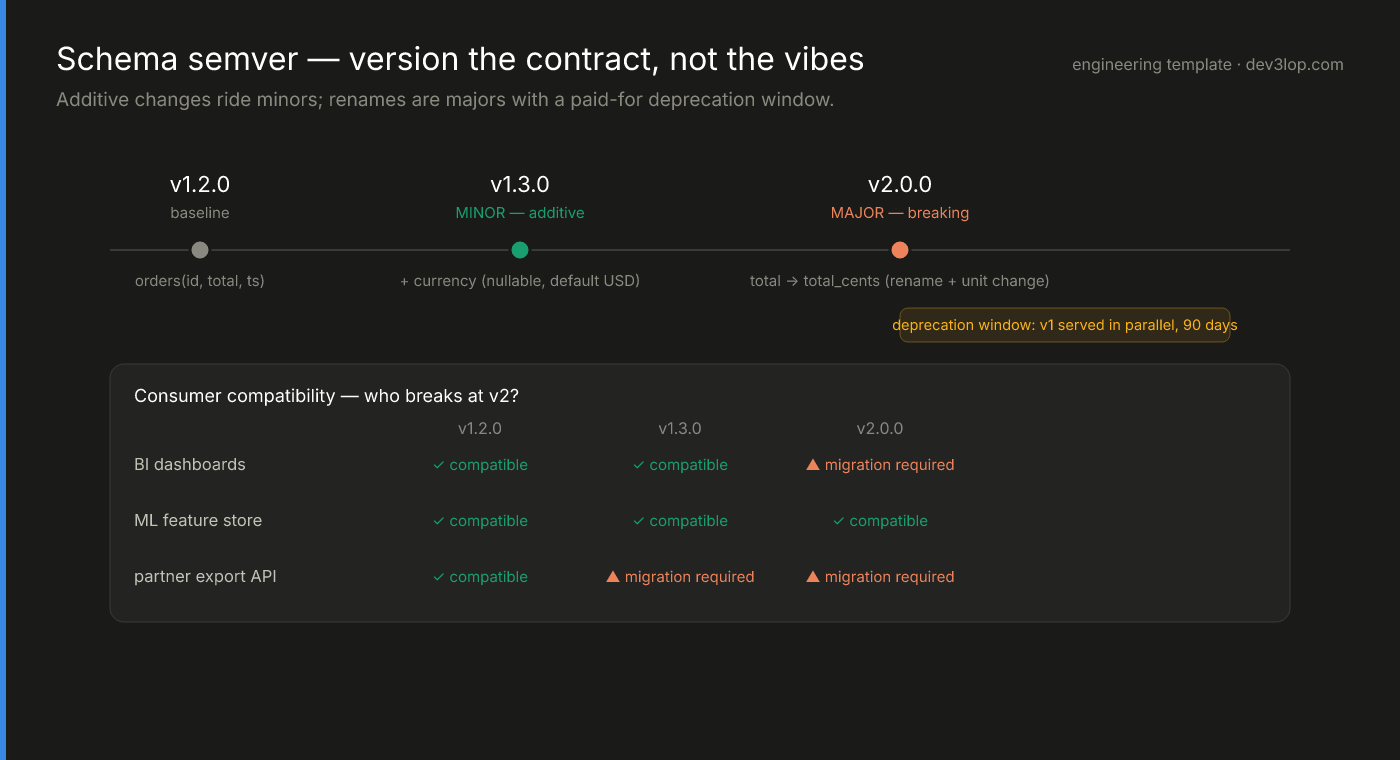
Schema changes as contracts, not surprises
Additive changes ride minors; renames are majors with a paid-for deprecation window — and a consumer compatibility matrix that catches the strict parser that breaks even on a "safe" minor. We publish our engineering patterns as teachable diagrams, because architecture you can audit is architecture you can trust.
Read the schema-semver walkthrough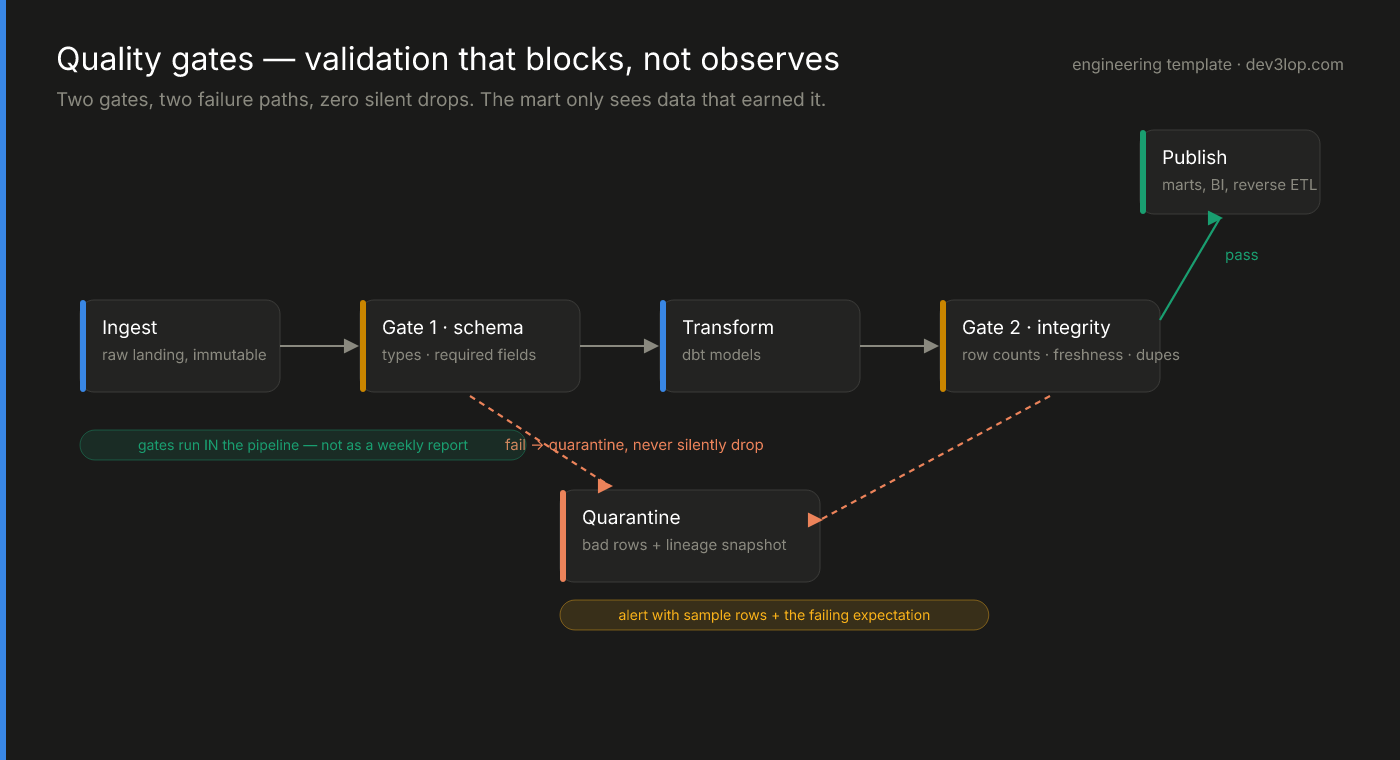
Quality gates that block, not observe
Validation lives in the pipeline, failures route to quarantine with lineage — never silently dropped — and alerts carry sample rows plus the failing expectation. The same gate architecture we install in client pipelines, drawn and explained.
Read the validation-gates walkthrough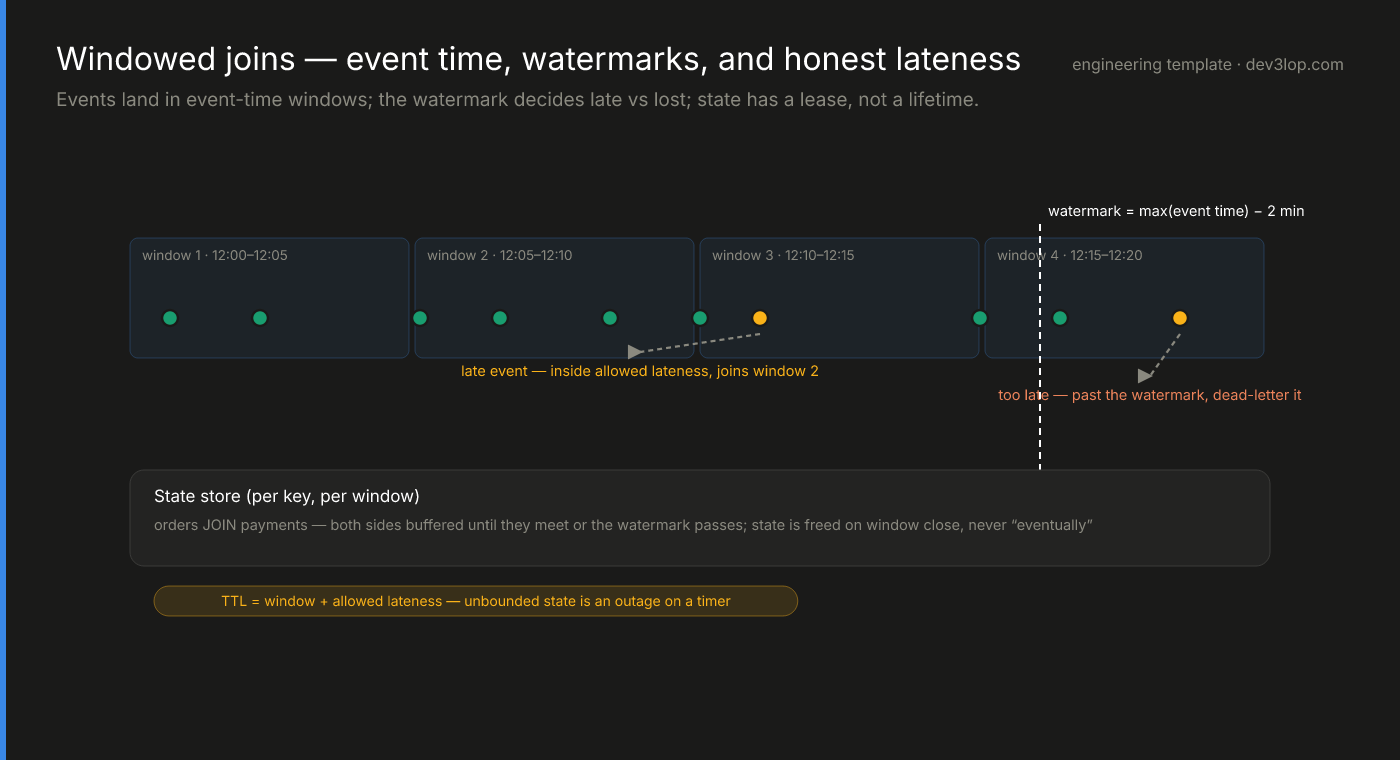
Streaming joins with honest lateness
Events belong to when they happened; the watermark decides late vs lost; state has a lease, not a lifetime. Three numbers — window size, allowed lateness, TTL — are the whole design, and we draw exactly how they keep state stores from becoming incident reports.
Read the windowed-joins walkthrough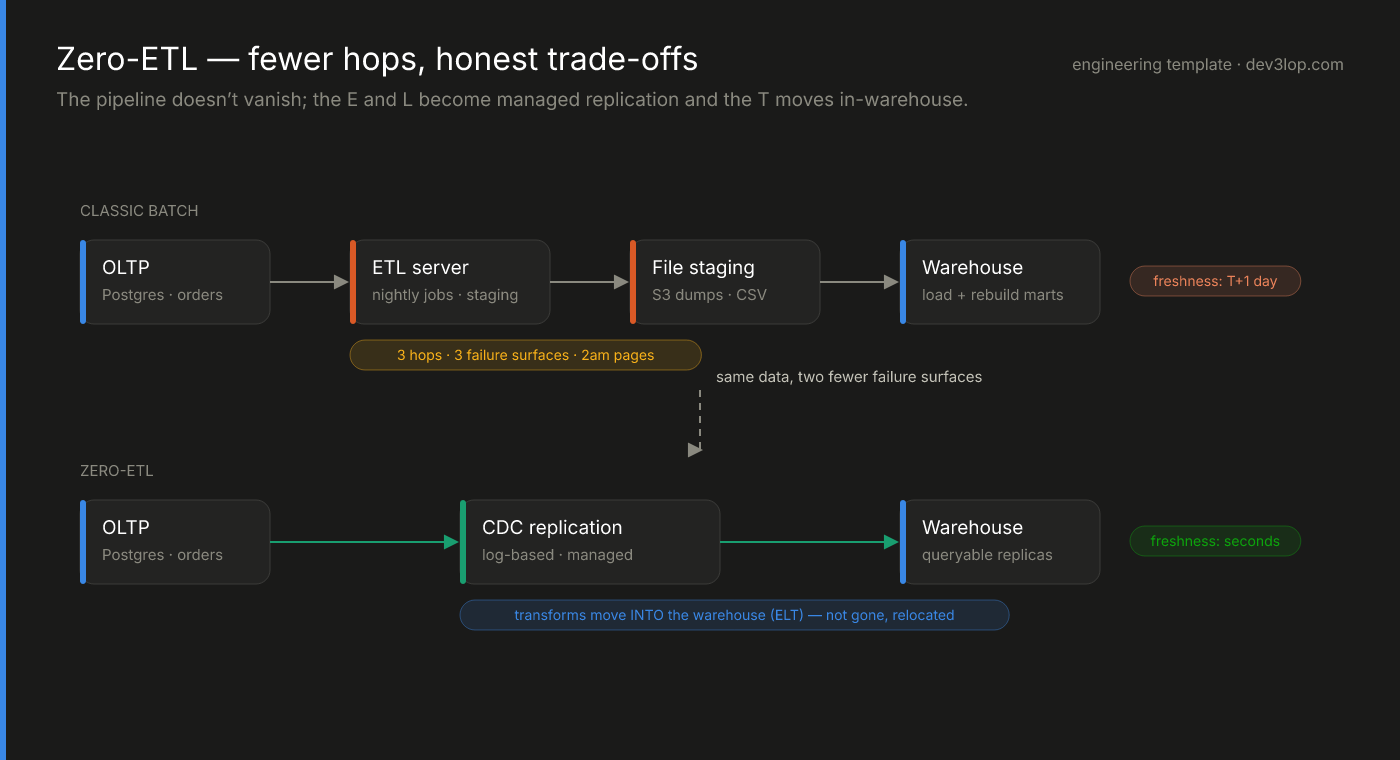
Zero-ETL without the marketing
Three batch hops collapse into one managed CDC hop and freshness moves from T+1 day to seconds — but the T doesn't vanish, it relocates in-warehouse as version-controlled ELT. We draw both the win and the fine print, because that's what an architecture decision actually needs.
Read the zero-ETL walkthrough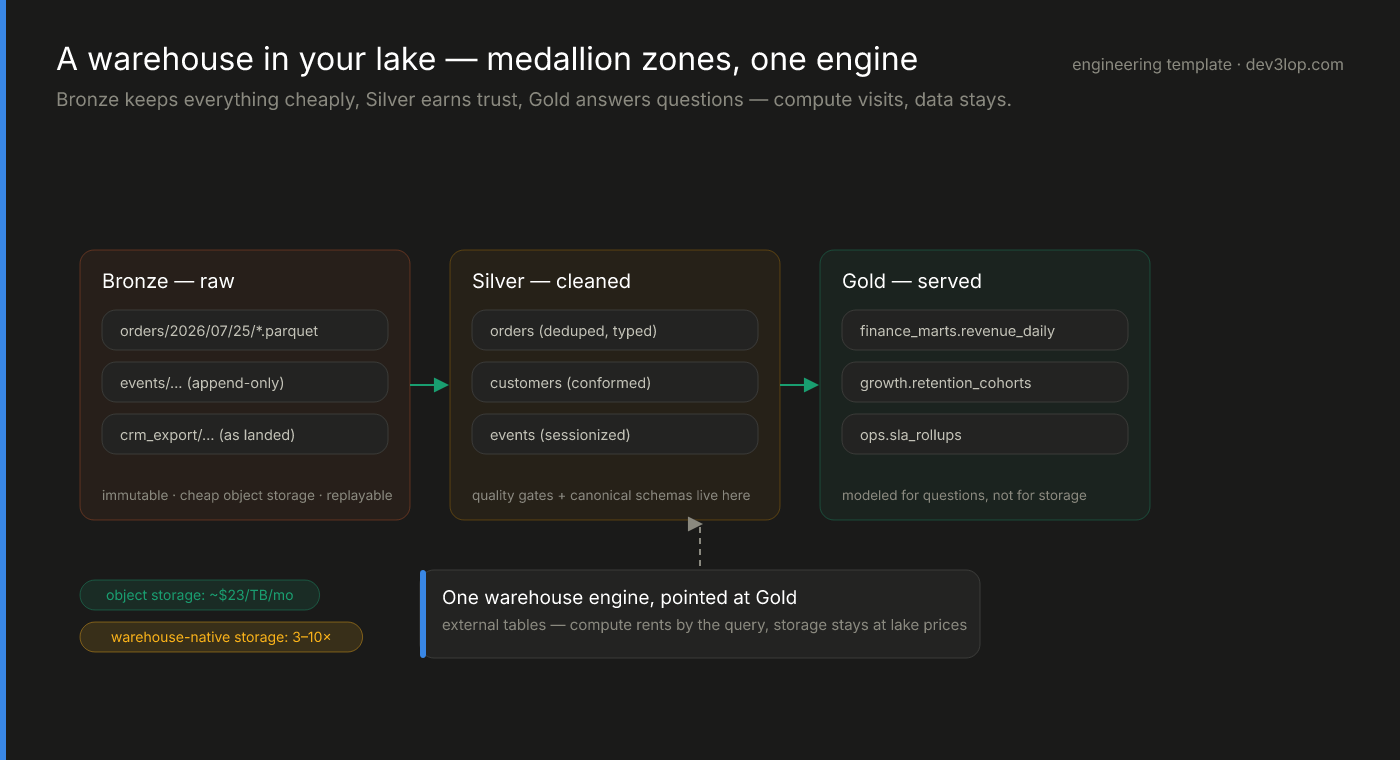
A warehouse in your lake
Bronze keeps everything cheaply, Silver earns trust at the gate, Gold answers questions — and one warehouse engine visits the data through external tables instead of the data migrating to 3–10× storage prices. Compute visits; data stays; portability becomes a day-one storage decision.
Read the lakehouse walkthroughOur data engineering services.
Hover any tile to learn more about how we can help.
Gap Analysis
Assessment · Roadmap
HoverGap Analysis
Comprehensive data engineering gap analysis to gain satellite visibility into your environment. Identify gaps and get tailored recommendations.
Staff Augmentation
Full-time · Part-time
HoverStaff Augmentation
Experienced data engineers to maintain your environment and pipelines. Long-term support on a schedule that works for you.
Webhook Development
APIs · Real-time
HoverWebhook Development
Custom webhook applications and API integrations. Connect your systems with real-time data flows and event-driven architectures.
End-to-End Delivery
Full stack · Dashboards
HoverEnd-to-End Delivery
From APIs and webhooks to dashboards and data products. We create custom solutions with you from concept to production.
Data engineering for teams that need the data layer to just work
DEV3LOPCOM, LLC is a data engineering consultancy based in Austin, Texas. We build the layer between your operational systems and the people who need answers: ingestion pipelines, APIs and webhooks, warehouse models, automation, and the monitoring that keeps all of it honest. Everything is delivered by senior, 100% onshore engineers — no offshore handoff, no junior bench learning on your invoice.
The work spans the practical middle of the stack. Pulling data out of SaaS tools and internal databases. Modeling it so analysts stop writing the same joins five different ways. Automating the manual exports someone runs every Monday. Wiring event-driven flows so systems react in real time instead of overnight.
How an engagement runs
Every project follows the same arc: assess, design, build, hand off. The assessment maps your sources, pipelines, and reporting surfaces and identifies where things break or where humans are quietly doing a machine’s job. Design turns that into a target architecture with clear trade-offs — what to buy, what to build, what to delete. The build phase ships in small, reviewable increments with tests, alerting, and documentation as part of the definition of done. Handoff means your team can run and extend the system: runbooks, architecture notes, and working sessions, not a zip file and a goodbye.
For teams that need ongoing capacity rather than a project, we also embed engineers directly through staff augmentation, on full-time or part-time schedules.
Problems we get called in for
- Pipelines held together by cron jobs and tribal knowledge, where one departure would strand the company.
- Spreadsheet-driven processes that consume analyst days and still produce numbers nobody fully trusts.
- Source systems that can’t talk to each other, so teams re-key data between tools by hand.
- Dashboards that are slow or wrong because the modeling underneath them was never designed, only accumulated.
Beyond the on-site work above, we have engineered at serious scale. At Nielsen we built pipelines processing trillions of records, where query design and aggregation strategy decide whether an answer takes seconds or hours. At Lever we consolidated 282 SQL queries, 186 Tableau workbooks, and 11 Python apps into a maintainable system that saves about 22,000 hours a year.
Why dev3lop
Our founder is a former Tableau Software Professional Services consultant, so the pipelines we build are designed with the end of the line in mind: a dashboard a decision-maker actually trusts. That perspective is why data engineering here connects cleanly to our advanced ETL consulting and data warehousing practices, and to Tableau consulting when the reporting layer needs the same rigor.
We stay small on purpose. You talk to the engineers doing the work, decisions are documented, and the system is built so your team owns it after we leave.
Talk through your data problem
Bring us the workflow that hurts — the failing pipeline, the manual process, the integration nobody wants to touch. We will scope an assessment and give you a straight answer on effort and approach. Contact us to get started.