In today’s data-driven landscape, the ability to harness event streams in real-time is a growing must-have business capability. Analytics capabilities that once were the domain of specialized “big data” teams are now expected to deliver value immediately. Amidst this evolution, one particularly powerful approach stands out: windowed joins. Real-time analytics, when executed proficiently—leveraging proper management of state stores—enables timely, accurate, and actionable insights. But implementing windowed joins correctly requires understanding the intricacies of stateful data processing. Done right, these techniques not only improve analytics performance but also significantly boost organizational agility and responsiveness. So, let’s dive in and uncover the nuances of windowed joins and how managing state stores correctly will transform your data processing strategy.
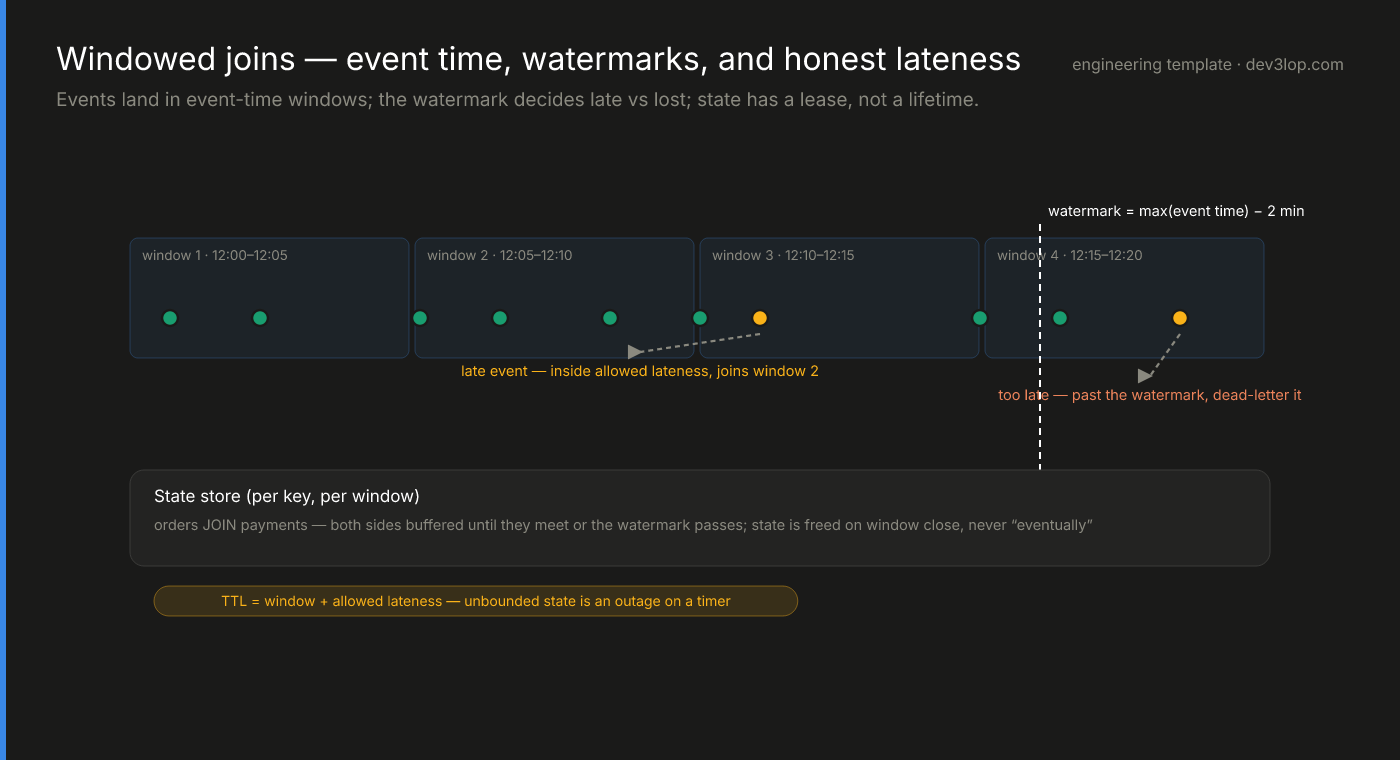
The diagram: the watermark decides late vs lost
Every streaming outage story eventually traces back to one of the three things drawn above. Event time vs arrival: events land in the window their timestamp says, not the window they happened to arrive during — the yellow dot arriving during window 3 still joins window 2, because that’s when it happened. The watermark is the system’s honesty deadline: max(event time) − allowed lateness. Inside it, late data joins its rightful window; past it, data goes to a dead-letter path where it’s visible — the respectable failure mode — instead of silently mutating totals you already reported.
And the chip at the bottom is the one production actually pages you about: state has a lease, not a lifetime. A join buffers both sides per key, per window, and frees on window close. Skip the TTL and your state store grows until the incident review — unbounded state is an outage on a timer. Three numbers configure this whole diagram: window size, allowed lateness, and TTL. Choosing them consciously is the design.
Understanding Windowed Joins in Real-Time Analytics
Before diving deep into best practices, it’s crucial we establish exactly what windowed joins are, especially within real-time analytic workflows. Windowed joins are structured processes where two streams of event-driven data are combined within a certain “window,” referring to a defined timeframe. Unlike conventional joins in traditional relational databases, windowed joins allow event streams—which flow continuously—to match events based on timestamp ranges or windows. This event processing technique becomes exceptionally valuable in use-cases ranging from real-time fraud detection to predictive analytics in sales forecasting.
Implementations of windowed joins need to take into consideration temporal properties like event-time, processing-time, and ingestion-time semantics. For example, in scenarios dealing with time-sensitive business decisions such as inventory management or promotional evaluations, windowed joins ensure that events occurring closely together in time are accurately correlated. Proper configuration of window lengths and handling of late-arriving events greatly impact these analytics’ effectiveness. Moreover, by effectively consolidating event data within time-bounded windows—organizations gain unparalleled clarity into rapid decision-making scenarios. For businesses seeking to apply sophisticated analytics, it becomes pivotal to understand cross-pipeline data sharing exchange patterns and formats to maximize data handling consistency at scale.
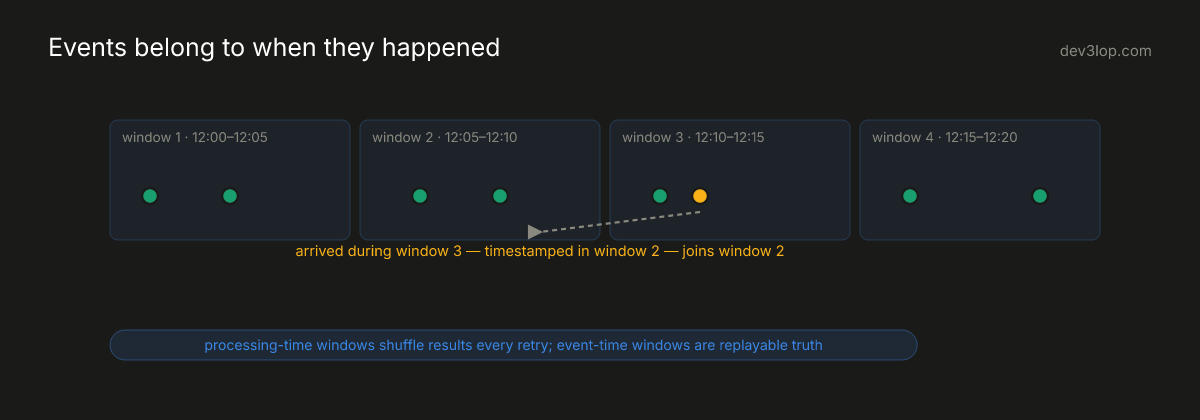
Before state management means anything, this distinction has to be solid: events belong to when they happened, not when they arrived. The yellow event shows up during window 3 carrying a window-2 timestamp — and it joins window 2, because that’s the truth. The alternative (processing-time windows) produces results that reshuffle on every retry, every backfill, every network hiccup: same data, different answers. Event-time windows are what make a streaming pipeline replayable — run it twice, get the same totals — and replayability is the property every downstream consumer is silently betting on.
The Importance of Efficient State Management
Windowed joins are inherently stateful operations—meaning they require storing and updating intermediate state during processing. As events steadily arrive in real-time, windowed join operations must hold temporary snapshots of event data within their defined time windows. An efficient state management solution stores and retrieves information quickly and reliability, thus delivering consistently high performance at scale. Inefficient management of state stores leads to delays, excessive memory consumption, and occasionally inaccurate analytics results, ultimately undermining the goals of your real-time analytics strategy.
One technique organizations can leverage when implementing state management is the principle of data locality. “Locality” refers to storing and processing data as closely as possible to its source and consumption point—minimizing latency and ensuring fast analytics performance. To better comprehend how locality plays a critical role in analytics performance, consider exploring data locality principles for faster analytics. Further, mastering state management demands not just efficient storage but structured modeling of the underlying data usage scenarios. Data modeling helps shape optimal data structures, ensuring faster retrieval and accurate analytics. Organizations new to this concept could significantly benefit by first attaining a basic understanding through a beginner’s guide to data modeling for analytics.
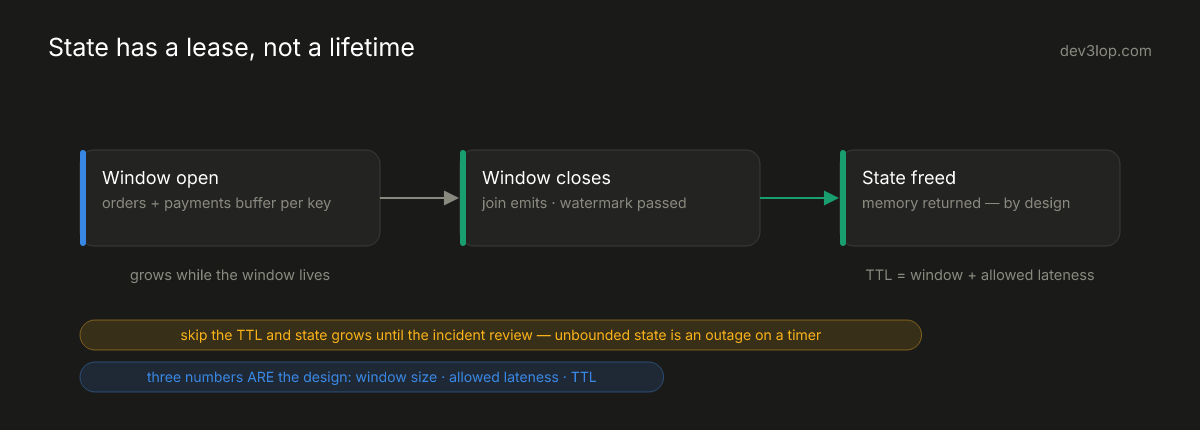
Here’s the lifecycle that keeps state stores from becoming incident reports. While a window lives, both sides of the join buffer per key — that growth is normal and bounded only if the close is guaranteed. The watermark closes the window, the join emits, and the state is freed by design, with a TTL of window-plus-allowed-lateness as the backstop. Skip that TTL and every key that never gets its matching event becomes a permanent tenant; the store grows quietly for weeks and then becomes the outage nobody can explain. Three numbers are the whole design: window size, allowed lateness, TTL. Choose them consciously and everything downstream is arithmetic.
Implementing Effective Windowed Join Strategies
While windowed joins undeniably transform your real-time analytics capabilities, actual implementation demands diligence and smart strategies. First, clearly define your business use-case requirements. This determines the ideal windowing approach, such as tumbling windows, sliding windows, or session windows. Determining this accurately aligns processing with your operational goals—for instance, tumbling windows best analyze structured, evenly spaced business events, while session windows manage user behavior tracking more effectively.
Beyond choosing window types, thoughtful consideration around precisely aligning event matching logic is crucial. Businesses often employ fuzzy matching algorithms or entity resolution methods when exact joins aren’t always possible because of time discrepancies or inconsistent data across pipelines. Understanding methods like fuzzy entity resolution techniques for master data management or adopting cross-domain identity resolution for entity consolidation ensures maximum relevancy of joined events within windows.
In applying business logic, maintain state granularity as minimal as necessary—too fine-grained datasets can slow retrieval or store unnecessary information; overly coarse-grained data could lead to loss of critical insights. Striking such a balance is easier with clearly modeled events facilitated through efficient ETL processes designed to clean and transform messy data sets. This ensures clarity and streamlined analysis between windowed event streams.
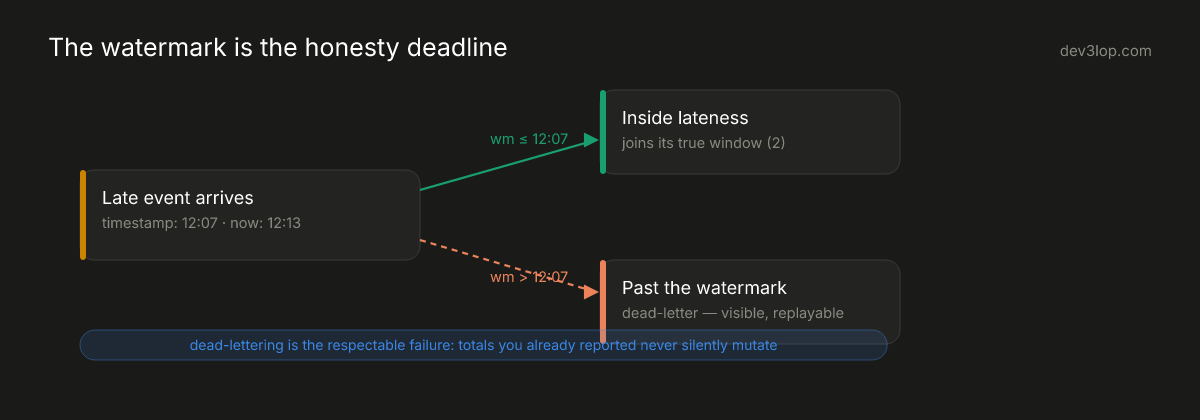
Every strategy above funnels into this one branch. An event arrives late: if the watermark hasn’t passed its timestamp, it joins its rightful window and the world is consistent. If the watermark has passed, the event goes to a dead-letter path — visible, counted, replayable — rather than back into totals you already reported. That’s the respectable failure mode, and it’s a business decision disguised as a config value: allowed lateness is literally “how long are we willing to keep results provisional in exchange for completeness?” Finance wants a longer window than the live ops screen. Write that down before tuning it.
Deep Dive: Technology Choices for Efficient State Store Management
Efficiently managing state requires technology solutions built specifically for stateful processing in streaming environments. Proven technologies, like Apache Kafka Streams, Apache Flink, and Apache Spark, offer built-in platforms to manage appropriate state stores optimized for rapid event processing. Apache Kafka Streams, for instance, enables interactive queries against state stores, helping applications easily retrieve stateful data across real-time analytical workloads.
Critical success requirements include fault-tolerance, scalability, and seamless distribution across event-processing cluster nodes. Choosing the technology stack providing distributed state stores with features like incremental checkpointing and robust scalability ensures your analytics applications perform continuously, reliably, without bottlenecks. Consulting experts on underlying technology decisions can help avoid implementation pitfalls; leveraging strategic data engineering consulting services can clarify which solution aligns optimally with your organization’s analytics objectives and infrastructure needs.
Further, automating classification and sensitivity management around your data store helps meet compliance requirements seamlessly. To understand how automation aids in achieving regulatory compliance effectively, you can explore the concept more extensively through automated data sensitivity classification using machine learning (ML).
Getting More from Your Windowed Joins: Visualization and Actionable Insights
A final strategic consideration for your windowed join endeavors includes presenting results in intuitive visual formats. Interactive visualizations—like dashboards dynamically connected to real-time analytics—allow stakeholders to grasp key changes as they unfold. Implementing visualization techniques, such as violin plot implementations for distribution visualization or leveraging analyses that enable interactive exploration through zoom and pan interactive methods, empower users to deeply engage and derive actionable insights quickly.
Connecting these insights to tangible business outcomes—such as effective strategies that boost sales and revenue growth—helps your organization realize direct, quantifiable benefits from windowed joins and state store management. Bridging analytics results with visualization empowers not just analytics teams, but broader business stakeholders, resulting in quicker decisions, greater confidence, and ultimately successful, insight-driven strategic moves.
Conclusion: Power Your Innovation with Robust Windowed Joins
Windowed joins and intelligent state store management represent a cornerstone capability of modern data-driven analytics. Properly implemented, these unlock immediate analytic feedback loops, accurate real-time insights, and smarter outcomes. Success starts by comprehensively understanding windowed join logic, thoughtfully considering your implementation strategies, choosing robust technologies, and visualizing results powerfully for all stakeholders. By following these guidelines, your organization can confidently transform diverse event streams into critical business opportunities.