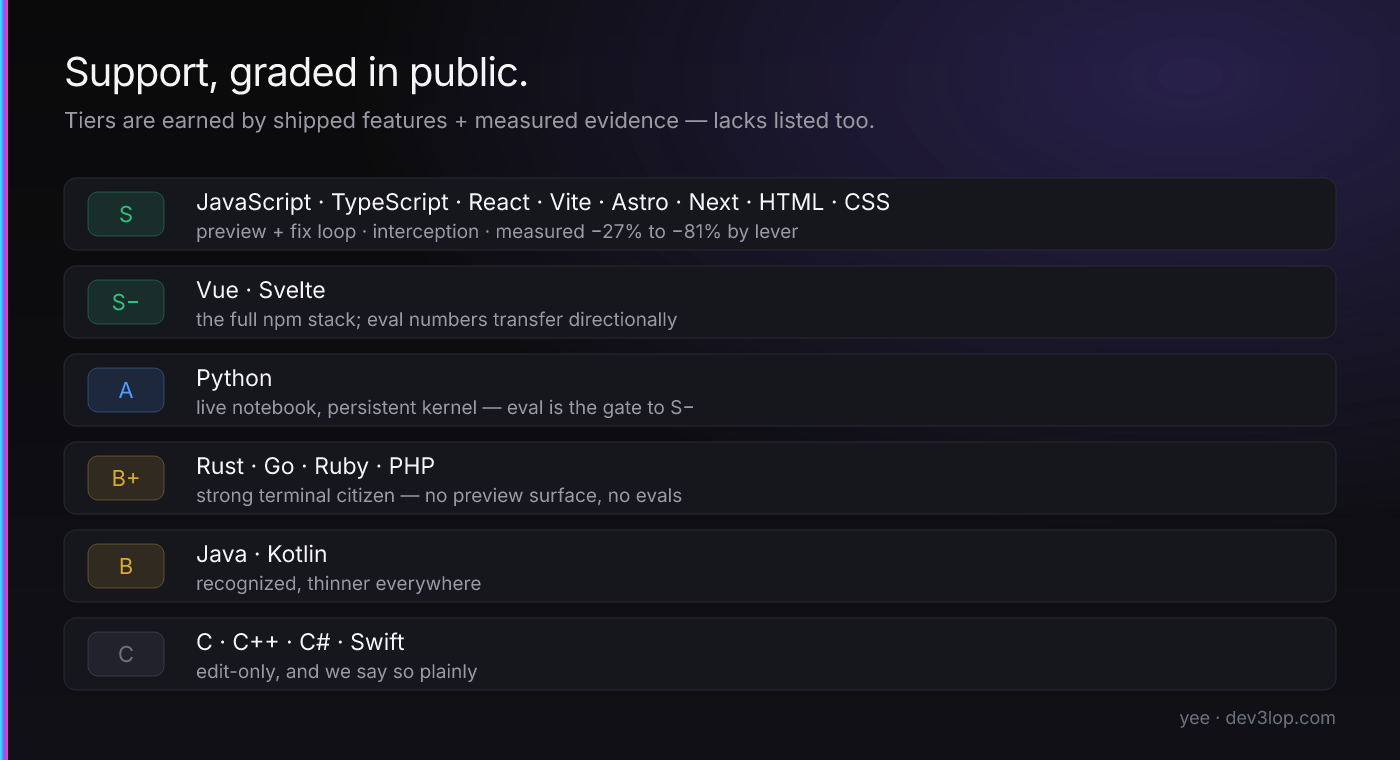
Open the model room in Yee and you’ll see a card most products would never ship: our own language support, graded S to C, with tooltips that list what each tier has — and what it lacks. The C tier ends with a line our lawyers would hate if we had lawyers:
“honestly: Cursor / Claude Code may serve you better here today.”
That sentence is in the shipped product, rendered to paying-attention users, about our own weakest surface. This post is about why it’s there and how the ladder works.
Tiers are earned, not declared
The ladder lives in one file, governed by one rule, stated at the top of the source:
“Tiers are earned by shipped features + measured evidence — when LANGUAGES.md moves a language, move it here in the same commit. Tooltips say what we ARE and what we are NOT, so users can calibrate before they invest.”
Concretely, the rungs today:
- S — JavaScript, TypeScript, React, Vite, Astro, Next, Tailwind, HTML, CSS. The full measured stack: live preview with hot reload and the AI fix loop, redundant-command interception (the editor never re-runs your dev server to “verify”), repo-map and ranged reads with token savings measured lever by lever, and every eval number we publish was earned here.
- S− — Vue, Svelte. Everything S has when the repo is npm-based — docked one notch because the eval scenarios aren’t framework-specific yet, so the numbers transfer directionally rather than exactly.
- A — Python. A notebook the agent can edit but never run: persistent kernel, plots, pandas tables, zero Jupyter installed. It’s not S− yet for one reason, and the source states it as a house rule: “no tier claim without a bench cell.”
- B+ — Rust, Go, Ruby, PHP. Strong terminal citizens: symbols, edits, per-language error detection, dev-command interception that knows
cargo runfromrails s. No preview surface, no evals — so no higher grade. - B — Java, Kotlin. Recognized, thinner everywhere.
- C — C, C++, C#, Swift, Lua, Elixir. “Edit-only — and we say so plainly.” Competent general editing, none of Yee’s differentiated tooling fires, and then the competitor sentence.
The grades even adapt per repo: open a project and the editor counts file extensions, maps them through the ladder, and answers the only question that matters — what is Yee for THIS repo — with the dominant stack’s tier first.
Why grade yourself in public?
Three reasons, in ascending order of self-interest.
It’s the same contract as our metrics. We deleted our own fabricated savings numbers because an instrument that flatters itself is worthless. A capabilities page that says “supports 40+ languages!” is the same flattery in prose form. Every AI editor “supports” every language in the sense that a text box supports it. The honest question is which languages get the differentiated machinery — and that answer is a ladder, not a checkmark grid.
It routes the right users in. Yee is deliberately focused: web-first apps and Python notebooks are the product; the rest is not on the backlog. The tier card is that strategy, rendered. When a C-tier developer bounces after reading it, we didn’t lose a user — we skipped a bad review from someone we’d have disappointed anyway. The download flow on our site runs the same honest gate: pick your language, get a fit score, and the copy tells you straight when the answer is “probably not yet.”
It compounds trust where we ARE strong. The S-tier claims are aggressive — measured savings percentages, an interception system, a preview loop competitors don’t have. Those claims are believable because they sit on the same card that concedes C-tier weakness. Honesty about the floor is what makes the ceiling credible.
The rule you can steal
If you build developer tools: put your support claims in one file, make every claim cite either a shipped feature or a measurement, and force changes to move through that file in the same commit as the evidence. Then render the file to users, lacks and all.
It will feel like giving competitors ammunition. What it actually does is convert your capabilities page from marketing into an instrument — and instruments are what engineers trust.