Imagine standing at the intersection of your organization’s expanding data landscape, overwhelmed with fragmented databases or disjointed analytics tools, racking up unnecessary expenses daily. What if leveraging your existing data lake infrastructure, by strategically building a data warehouse within it, could dramatically decrease your operational expenses, simplify management, and provide accurate and timely analytics insights?
By seamlessly blending the flexibility of data lakes with the structure and robustness of data warehouses, you can streamline your data platform for unparalleled efficiency, cost reduction, and scalability. Let’s uncover why building a data warehouse in your data lake isn’t just a smart technical decision—it’s a transformative strategy to conquer rising costs, innovate faster, and propel your analytics capability further than ever before.
Keep it simple, use one source of truth in the beginning. You can do both data warehouse and data lake in the same storage space.
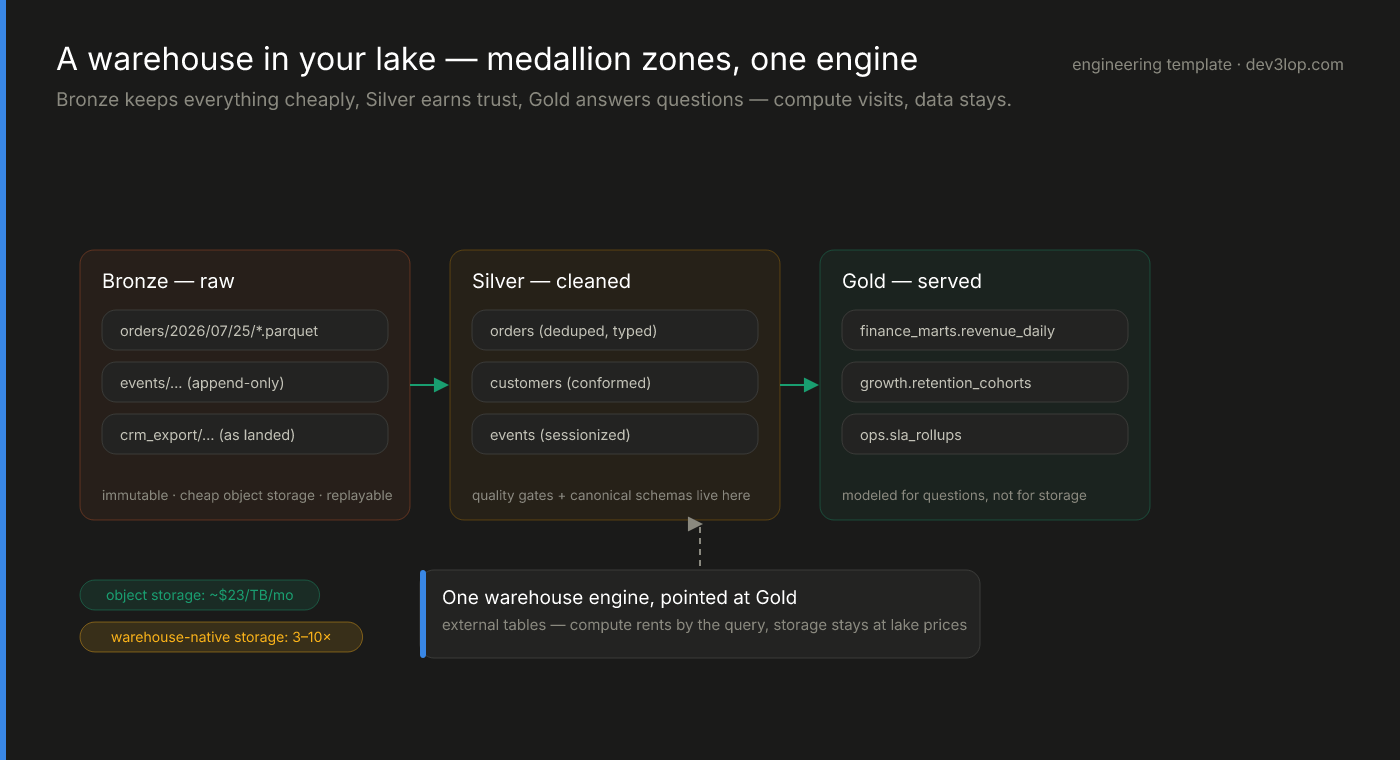
The diagram: compute visits, data stays
The three zones above are a promotion ladder, and the money argument lives in the chips. Bronze keeps everything, raw and append-only, at object-storage prices (~$23/TB/month) — cheap enough that “should we keep this?” stops being a meeting. Silver is where data earns trust: deduped, typed, conformed, with quality gates at the door. Gold is modeled for questions — marts shaped like the decisions they serve, not like the systems they came from.
The architectural punchline is the box at the bottom: one warehouse engine pointed at Gold through external tables. Compute rents by the query; storage never migrates into warehouse-native formats billed at 3–10× lake prices. That inversion — move the engine to the data instead of the data to the engine — is the entire “warehouse in your lake” savings story, and it’s also what keeps you portable: the day you switch engines, your data doesn’t move, because it never moved in.
Understanding Data Lakes and Data Warehouses: Bridging the Divide
Organizations accumulating vast amounts of data often wrestle with choosing between data lakes and data warehouses, or neither and excel rodeo.
All have distinct benefits: Data lakes excel at handling raw, unstructured information, allowing you to store large volumes of diverse data cheaply and flexibly. On the other hand, data warehouses, built to store structured, processed data, are optimized specifically for analytics speed and consistency. However, the traditional approach of keeping these solutions separate often leads to increased complexity, inefficiencies, large skill gaps, and unnecessary costs. Also, leads to excel.
Merging these powerful platforms yields remarkable advantages, creating a harmonious data environment. A data warehouse embedded inside an existing data lake might sound complex but is surprisingly efficient. It takes advantage of cloud infrastructure, uniting disparate data sources, streamlining analytics workloads, and substantially reducing administrative overhead. Need a refresher on the fundamentals? Check out our Beginner’s Guide to Data Warehousing for a clear definition and baseline understanding of this essential technology.
Instead of maintaining separate infrastructure stacks—and expensive replicative processes—you gain the ability to query structured warehouse-developed data alongside raw data directly in your data lake. This consolidated approach optimizes performance, simplifies updates, and ultimately allows your analytics teams to deliver insights faster. A unified data architecture positions you strategically towards innovation, empowering your business decisions rather than restricting them. 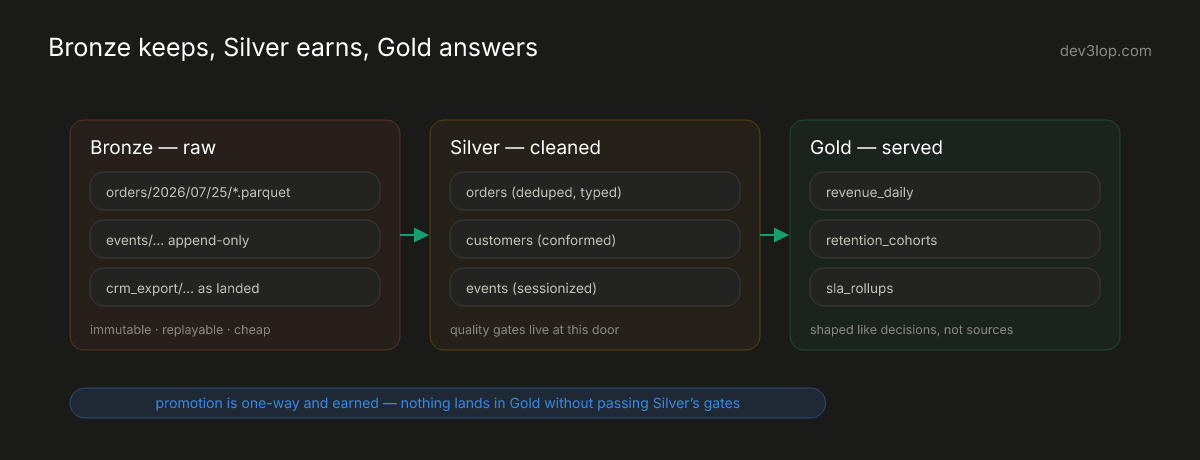
The zones bridge the divide because each one keeps a different promise. Bronze promises nothing except completeness — raw, append-only, exactly as landed, which makes it the replay buffer for every future logic fix. Silver is where data earns trust: deduplication, typing, conformed entities, with quality gates standing at the door. Gold promises relevance — marts shaped like the decisions they serve, not like the systems they came from. Promotion is one-way and earned; nothing shortcuts into Gold. That single discipline is what lets a lake stop being the “data swamp” the warehouse vendors warn you about.
Optimize Costs Through Data Consolidation and Streamlined Processes
The principal advantage of integrating your data warehouse inside your data lake is substantial cost optimization. By consolidating these technologies, you significantly reduce duplication of data storage and eliminate sources of operational complexity. In a unified architecture, teams no longer need to move or replicate data across various independent platforms, cutting down excessive data ingress and reducing infrastructure bills dramatically.
Additionally, operating analytics out of one integrated platform means faster query times, streamlined ETL processes, and improved responsiveness. Data scientists and analysts can work directly with optimized and pre-processed data alongside raw datasets, creating advantages in speed and interactivity. Curious on how to improve your ETL techniques? Explore our in-depth resource: How to Use ETL to Clean and Transform Messy Data Sets.
Administrative overhead is another cost-heavy sinkhole organizations don’t often anticipate. Managing separate data stacks means higher staffing costs and redundant skills requirements. By incorporating a data warehouse into your data lake, organizations need fewer specialized staff, simplify security compliance operations, and lower technical debt accumulation. Your business becomes leaner, more agile, and fully primed to capitalize rapidly on digital opportunities without extensive upfront expenses. 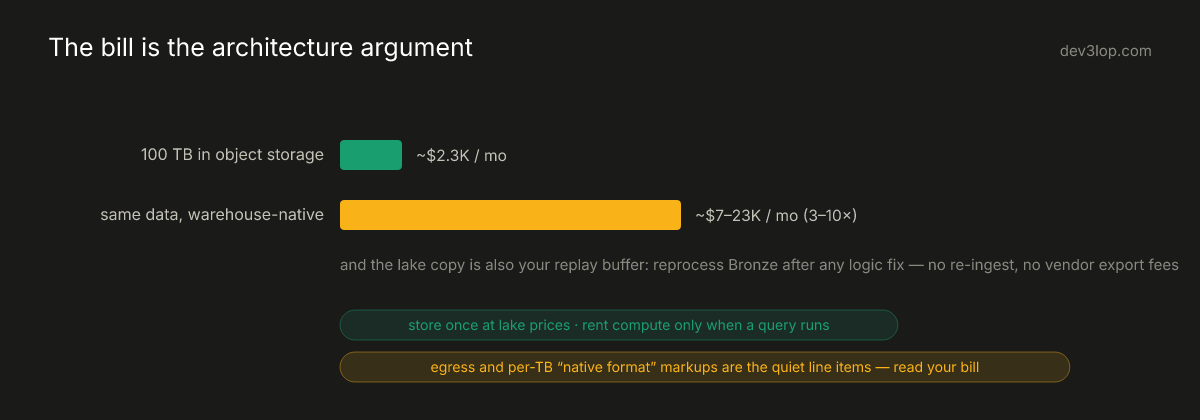
Here’s the consolidation math with real numbers on it. A hundred terabytes in object storage runs about $2.3K a month; the same data migrated into warehouse-native formats bills at 3–10× that, before egress and per-TB “native format” markups — the quiet line items worth hunting for in your invoice. And the lake copy isn’t just cheaper, it’s working storage: when a transform bug surfaces in March, you reprocess Bronze instead of begging source systems for re-exports. Store once at lake prices, rent compute only when a query actually runs — that sentence is the budget case, and it survives procurement review.
Empowering Advanced Analytics and Predictive Insights
With streamlined data processes and consolidated data management, your organization’s capacity to perform sophisticated analytics exponentially increases. Advanced analytics—including machine learning models, AI-driven forecasting, and predictive data tools—benefit immensely from integrated data lakes and warehouses. Such architecture facilitates more accurate and rapid forecasting, demand prediction, and operational analytics.
Consider demand forecasting across industries. An efficient, integrated architecture allows data teams to deploy predictive models quickly, delivering insights with greater accuracy. Access insights about effective forecasting models in our recent guide Accurate Demand Prediction: Unlocking Business Success Through Precise Forecasting. Similarly, predictive analytics can significantly boost efficiencies in supply chain management; learn more in our comprehensive blog post: Mastering Demand Forecasting with Predictive Analytics.
A unified data platform also benefits teams in healthcare, finance, retail, and beyond. In healthcare, for instance, transforming operations and aligning analytics across data platforms delivers better outcomes, as highlighted in our industry-focused article How Data Analytics is Transforming the Healthcare Industry in Austin. Businesses gain accelerated time-to-insight, leveraging their analytics investments to uncover market trends earlier, respond faster, and anticipatively outperform competition. 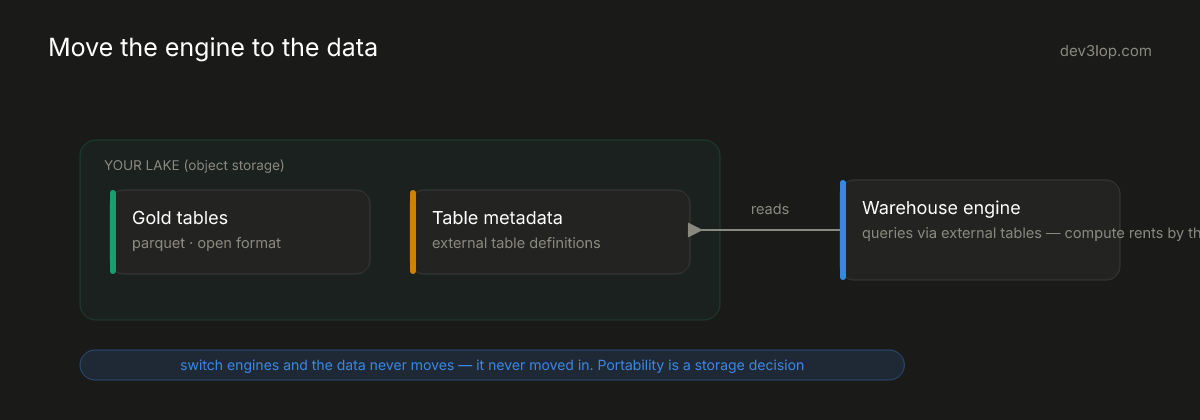
And the piece that makes implementation simpler than it sounds: the engine arrangement. Gold tables live in the lake in open formats; the warehouse engine reads them through external table definitions and rents compute by the query. Nothing migrates, so there’s no migration project — pointing the engine at the metadata is the integration. The strategic bonus compounds later: the day you want a different engine (or a second one for a different workload), the data doesn’t move, because it never moved in. Portability turns out to be a storage decision you make on day one, not an exit project you fund in year three.
Simplified Technical Implementation with The Right Tools
Building a data warehouse inside your data lake may seem intimidating, but modern data infrastructure and available tools make the process approachable, efficient, and cost-effective. Cloud providers like AWS, Azure, and Google Cloud support managed services that seamlessly blend lake and warehouse functionalities, reducing the complexity of setting up and maintaining this dual architecture.
SQL languages and database optimization tools have transformed how data is integrated, queried, and visualized within these complex environments. Familiarity with SQL’s powerful join types becomes invaluable when merging multiple data sources efficiently. Get up to speed quickly with our detailed review on SQL data integration approaches: Understanding SQL Join Types: Unlocking the Power of Data Integration.
Visualization platforms like Tableau, Google Data Studio, or open-source analytical tools significantly simplify sharing powerful analytics results with broader audiences. Tableau integrations can easily be set up for your data environment—refer to our walkthrough on how to install Tableau Desktop. Prefer cloud-based visualization? Understand embedding dashboards easily via our article on How to Embed Google Data Studio iframe.
Additionally, leveraging tools like Node.js can accelerate your data projects significantly. Consider upgrading your technical implementations by speaking with consulting experts about our Node.js Consulting Services. Having the right infrastructure and technical guidance drastically minimizes downtime, enabling quick wins and reducing the overall complexity and cost required for implementation.
Transform Your Data Strategy to Propel Business Success
In a world increasingly driven by analytical capability, businesses must rethink how they use, store, and optimize their data environments. By consolidating your data warehouse and data lake into one cohesive system, you gain a clear competitive advantage: cost-efficiency, reducing complexity, empowering predictive insights, and simplifying implementation.
Creating a data warehouse within your data lake isn’t simply a technological enhancement—it’s a strategic catalyst for growth. Your organization will benefit from streamlined operations, reduced complexity, and enhanced analytics capabilities, all translating directly to tangible cost savings and improved decision-making. Ready to launch your data consolidation journey? Contact our team of expert consultants today and build an innovation-driven data strategy that aligns with your business vision.